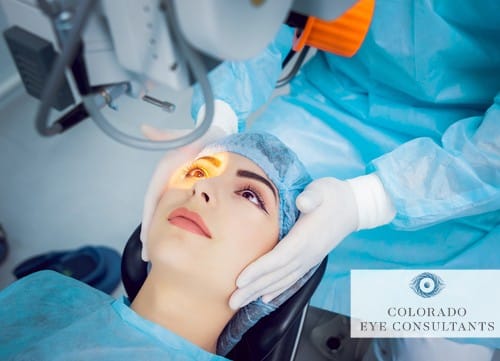

Were you told at a consultation that LASIK isn’t the right fit for your eyes? That news can feel like the end of the road for life without glasses or contacts, but for many patients, it simply points toward a different procedure.
Two of the most common alternatives are PRK and the EVO ICL. Keep reading to see how each one works, who tends to benefit, and how they compare side by side.
Why Some Patients Aren’t Good LASIK Candidates
LASIK corrects vision by creating a thin flap in the cornea and reshaping the tissue underneath with a laser. That approach works well for many people, but it depends on having enough healthy corneal tissue.
Patients with thin corneas may not have enough tissue to create a flap safely. People with high nearsightedness may need more tissue removed than their cornea can spare. Existing dry eye can also rule out LASIK, since the procedure can worsen dryness.
How PRK Works
PRK, or photorefractive keratectomy, uses the same type of excimer laser as LASIK to reshape the cornea. The difference is what happens first. Instead of creating a corneal flap, the surgeon gently removes the cornea’s thin outer layer, called the epithelium, and reshapes the tissue beneath it.
Without a flap, PRK leaves more of the cornea intact. This makes it a strong option for patients with thinner corneas and for people in contact sports or physically demanding jobs, where a blow to the eye could disturb a flap.
The tradeoff is recovery. A bandage contact lens protects the eye while the outer layer grows back, and vision may stay blurry for several days to a few weeks. Most patients reach their best vision after a month or longer.
How EVO ICL Works
The EVO ICL corrects vision without reshaping the cornea at all. The surgeon places a small, flexible lens behind the iris and in front of the eye’s natural lens. It works much like a contact lens, except it stays in place and needs no daily care.
The lens is made of collamer, a collagen-derived material the eye tolerates well. It corrects nearsightedness between -3.0 and -20.0 diopters, along with astigmatism between 1.0 and 4.0 diopters. Because no corneal tissue is removed, it typically doesn’t aggravate dry eye syndrome, making it a good fit for patients turned away from LASIK for that reason.
Comparing EVO ICL and PRK
1. Prescription Range
PRK generally works best for mild to moderate prescriptions. EVO ICL handles moderate to severe nearsightedness, including prescriptions too high for laser procedures to treat safely.
2. Corneal Tissue
PRK removes a small amount of corneal tissue to change the eye’s focusing power. EVO ICL adds a lens and leaves the cornea untouched.
3. Recovery Time
PRK has a longer recovery, with gradual improvement over several weeks. Many EVO ICL patients notice clearer vision almost immediately.
4. Dry Eye Considerations
Dryness is common while the eye heals after PRK, though it usually improves with time. EVO ICL patients typically avoid this side effect.
5. Reversibility
PRK permanently changes the shape of the cornea. EVO ICL is meant to be permanent, but a surgeon can remove it if needed, including later in life if cataract surgery becomes necessary.
Finding the Right Fit for Your Eyes
Neither procedure is better for everyone. The right choice depends on measurements taken during a thorough evaluation, including corneal thickness, prescription strength and stability, the depth of the space at the front of the eye, and tear film health.
Experienced surgeons at Colorado Eye Consultants perform both procedures, so each patient gets a recommendation based on their eyes and goals.
Wondering whether EVO ICL or PRK could be your path to clearer vision? Schedule an appointment at Colorado Eye Consultants in Littleton, CO, today.